What is this
"Ershov's Algorithm" is a browser-based engineering simulator where you build your own computer step by step from absolute zero. Starting with the simplest logic gates, you'll construct increasingly complex blocks: memory, flip-flops, an arithmetic-logic unit, and finally a full 8-bit processor that you'll program yourself in assembly. This game turns complex computer architecture into a visual puzzle, helping you forever lose your fear of the "black box" of computing.
What's inside
Let there be light!
Source → receiver. Your first wire.
Negation
NOT gate from a single NAND.
Perfect pair
AND gate from NAND and NOT.
At least one
OR gate via De Morgan's laws.
Strict choice
Exclusive OR (XOR).
Half Adder
Sum (XOR) + Carry (AND).
Full Adder
A, B, CarryIn → Sum, CarryOut.
8-bit Adder
Cascade of 8 adders. Buses.
Crossroads
MUX: digital 2-to-1 switch.
Loopback
SR latch from NOR. Foundation of memory.
Smart memory
D flip-flop. Captures on clock edge.
Register
8-bit register from 8 DFFs. One byte.
Heart of math
ALU: ADD, AND, OR, XOR, NOT, SHL, SHR.
Program Counter
PC from register and ALU. Address sequencing.
Decoder
Instruction → control signals.
FINALE: The Ershov Computer
Harvard processor. Build and program it!
What you'll learn

Step-by-step learning
16 levels take you from a simple wire through AND, OR, NOT gates, adders, flip-flops, registers, and an ALU to a fully working 8-bit processor. Each level unlocks new components.

Visual programming
No boring code at the start. Just an interactive canvas: drag elements, connect them, watch signals flow. Understanding comes through your hands — you literally see how every gate works.

Real architecture
You'll build a Harvard architecture processor — separate instruction and data memory, an ALU with 8 operations, general-purpose registers, a program counter. This is a simplified model of a real computer.
How it works
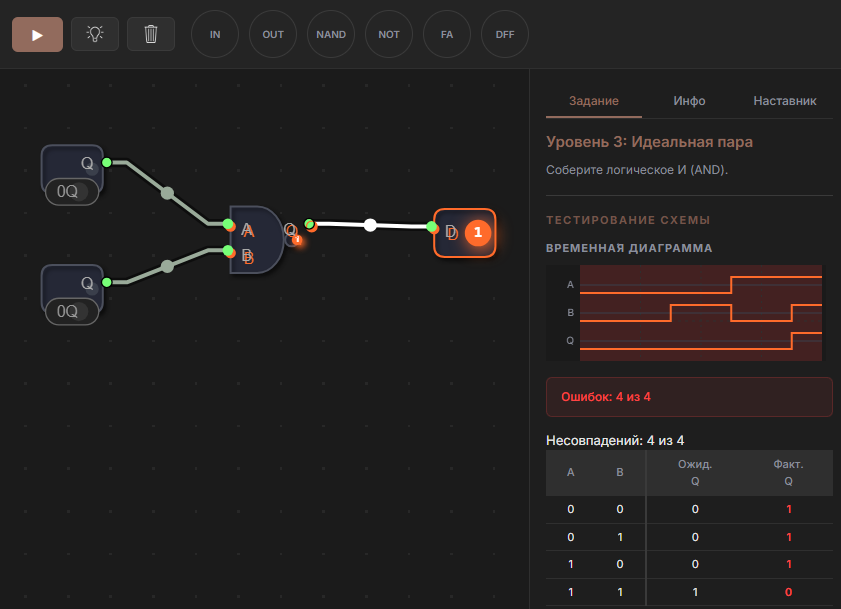
Build circuits from logic gates right in your browser. Drag components onto the canvas, connect them with wires, and see results instantly. The built-in checker compares your circuit against the truth table — you immediately see which bits match and which don't.
Advanced level
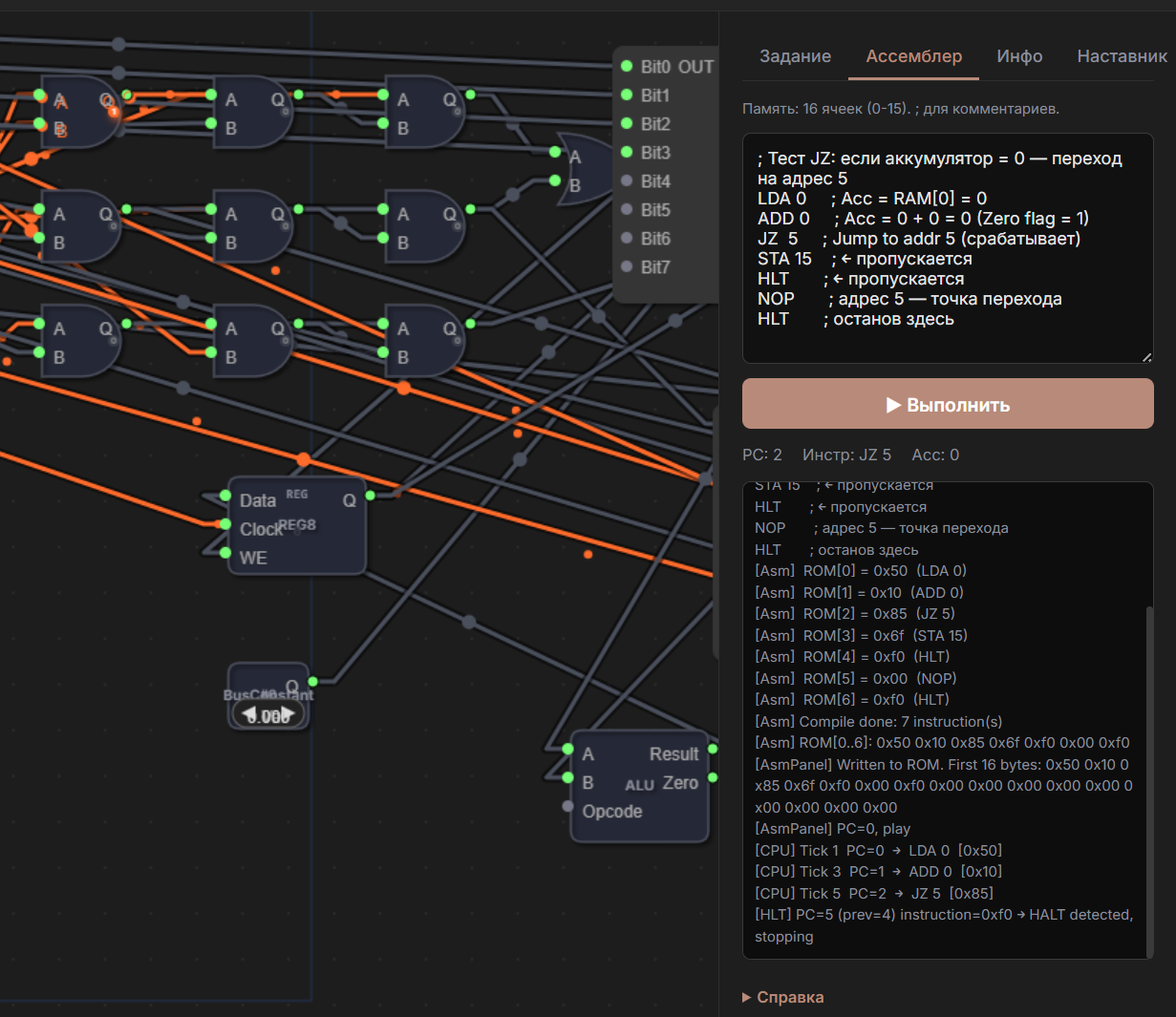
The game doesn't end with simple circuits. After building the basic processor, ROM and RAM modules, data buses, and instruction decoders await. You'll program your processor in a built-in assembler — writing real programs for the architecture you built with your own hands.
AI Tutor
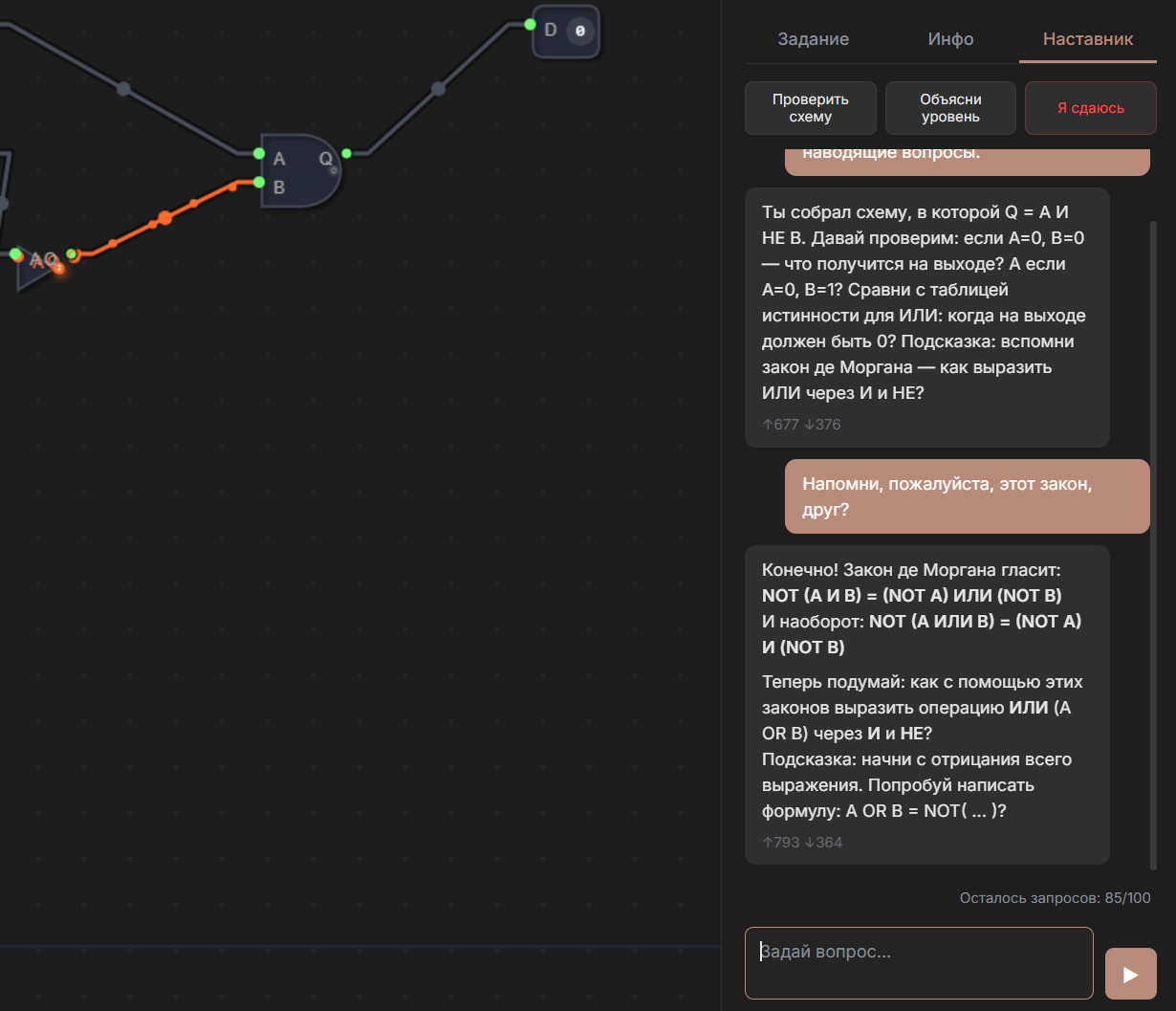
An AI assistant lives in the right sidebar. It analyzes your circuit, finds errors, and asks guiding questions to help you figure things out on your own. If you're truly stuck — it will show you a step-by-step solution.
Who is this for

Students
Computer science in practice. Live circuits you can touch with your mouse instead of dry theory.

Undergraduates
The perfect companion for a computer architecture course. All key concepts from gates to pipelining.

Enthusiasts
For everyone who always wanted to understand how computers really work, from silicon to code.
This is a CPU. Design your own!