The AND Gate
The AND gate is an element of strict agreement. It is needed when a decision requires multiple conditions to be met at the exact same time.
This gate has two inputs and one output. For a signal ("1") to appear at the output, voltage must be present at both inputs simultaneously. If only the first wire is active, or only the second, or if both are silent—the gate will not let the current pass, and the output will be a zero.
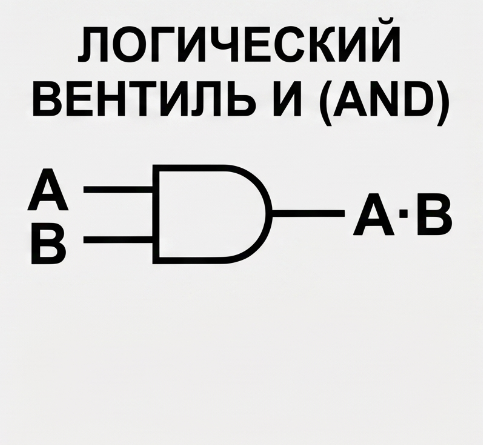
Visually, the AND gate is easy to recognize—it looks like the capital letter "D" with a flat left edge and a semi-circular right edge.
A great real-life example is a bank vault with two locks. To open the door, two different employees must turn their keys in the keyholes at the same time. One key alone won't do anything. Inside a processor, AND gates are constantly used as strict filters: for example, the processor will only allow saving a file IF the file is open AND the user has the permission to do so.