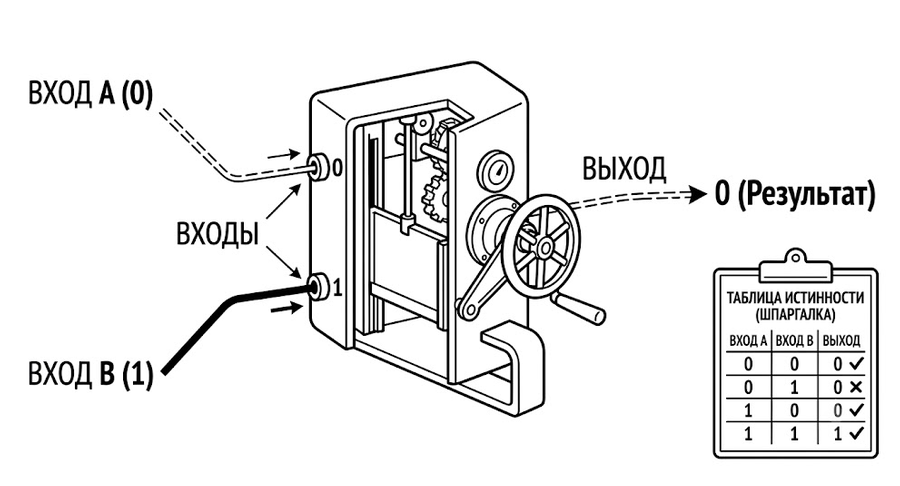
What Are Logic Gates?
In the previous article, we learned that a processor communicates exclusively in zeros (no voltage) and ones (voltage is present). But how does this simple flow of electricity turn into meaningful actions? This is where the main heroes of circuitry step onto the stage: logic gates.
The word "gate" is a perfect analogy. Imagine a gatekeeper or a checkpoint. A logic gate does exactly that, but with electrical current instead of people or cars.
At its core, a logic gate is a tiny, strict controller. It has inputs (doors where signals "knock") and one output (the door where the signal exits and travels further). When zeros and ones arrive at the inputs, the gate doesn't just let them pass freely. It looks at them and makes a decision based on a strictly defined rule.
For example, one gate might say: "I will only let the current pass if there is a signal on both inputs at the exact same time." Another might say: "A signal on just one input is enough for me." Each type of gate has its own unchanging character and its own rules of the game.
To make it easier for engineers to understand these rules, they use truth tables. This is a simple cheat sheet that lists all possible combinations of zeros and ones at the inputs and what the resulting output will be. In our simulator, you will constantly check these tables to see if your circuit is working correctly.
By themselves, single logic gates cannot solve complex problems. But if you connect them with wires—the output of one to the input of another—they start working as a team. This is exactly how, step by step, the complex mathematics of your computer is born from simple rules. Let's take a closer look at the basic gates.