The NOT Gate
The NOT gate (also known as an inverter) is the simplest yet an absolutely essential logic element. Its job is to do everything the other way around.
An inverter has only one input and one output. If an electrical signal (a logical one) enters the input, the gate blocks it, and we get silence (a zero) at the output. And vice versa: if there is no voltage at the input, the inverter generates a signal itself, outputting a one.
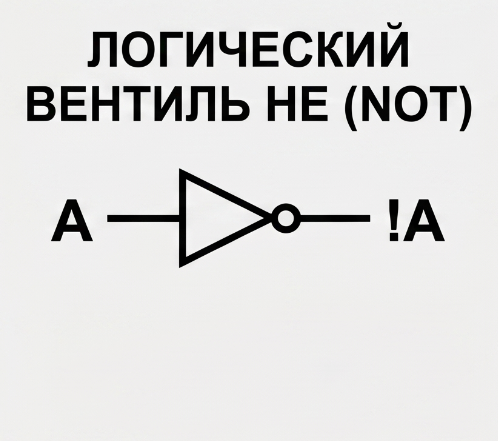
Visually, it is represented on circuit diagrams as an isosceles triangle with a small circle at its tip. This very circle is the universal symbol of logical negation in digital circuitry.
Where is this applied in real life? Imagine an automatic lighting system. It has a light sensor. The working logic is simple: IF the sun is NOT shining outside (a "0" at the sensor's input), the streetlights need to be turned on (a "1" appears at the inverter's output). The inverter forces the system to work in the opposite phase.