The OR Gate
The OR gate is a logic element that only needs any kind of activity to work. Unlike the strict AND gate, it is much more "agreeable."
It also has two inputs, and it will output an electrical signal ("1") if there is voltage on at least one of them. The current will pass through if only the first input is active, only the second input is active, or both at once. The only situation where an OR gate will output a zero is when there is complete silence on both inputs.
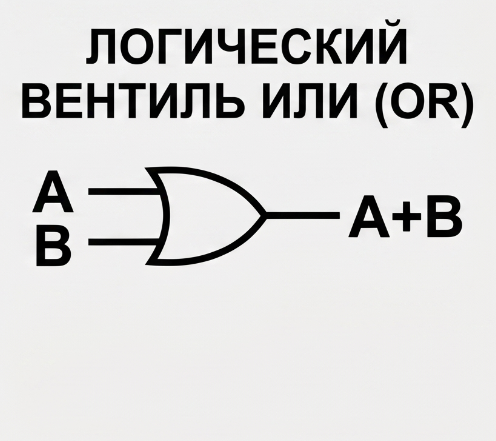
On circuit diagrams, this element is drawn in the shape of a pointed shield or a spearhead, with a curved concave line on the input side.
How does this work in reality? Imagine the lighting in a long hallway with switches at both ends. The light will turn on if you press the switch at the beginning of the hallway, OR at the end of the hallway. The system doesn't care exactly which switch was flipped—the main thing is that at least one signal was received.